
Economic data is everywhere, but making sense of it, and using it to guide decisions, is challenging. The Center for Economic Research (CER), housed in the College of Business, helps by transforming complex economic information into clear, practical analysis that supports decision-makers, strengthens communities, informs policy, and prepares students for data-driven careers.
The Center serves as a hub for applied economic analysis and regional impact studies. Its work helps business leaders, government agencies, and community organizations better understand how investments, industries, and public initiatives shape Louisiana’s economy, both now and into the future.
“What distinguishes this Center from others like it is its dual mission,” said Dr. Chris Martin, dean of the College of Business. “Alongside community outreach and applied research, the Center is intentionally designed as a student-engaged research engine, embedding graduate and undergraduate learning directly into its work.”
The Center’s projects focus on real-world questions with real consequences: Did the state’s cooperative endeavor with GDIT result in increased workforce and consumer demand? What is the economic impact of Shreveport’s Red River Revel or Ruston’s Peach Fest? What would a new development on Lake D’Arbonne do for the local economy?
“Every business and economic research center is slightly different in its mission,” said Dr. Patrick Scott, Center director, associate professor of Economics, and Patricia Garland Endowed Professor. “After reviving this Center in 2018, I really wanted to embrace a mission of student engagement through the research process. Unlike other research centers, the CER embodies a strong curricular engagement in tandem with the broader objective of community outreach through economic development research.”
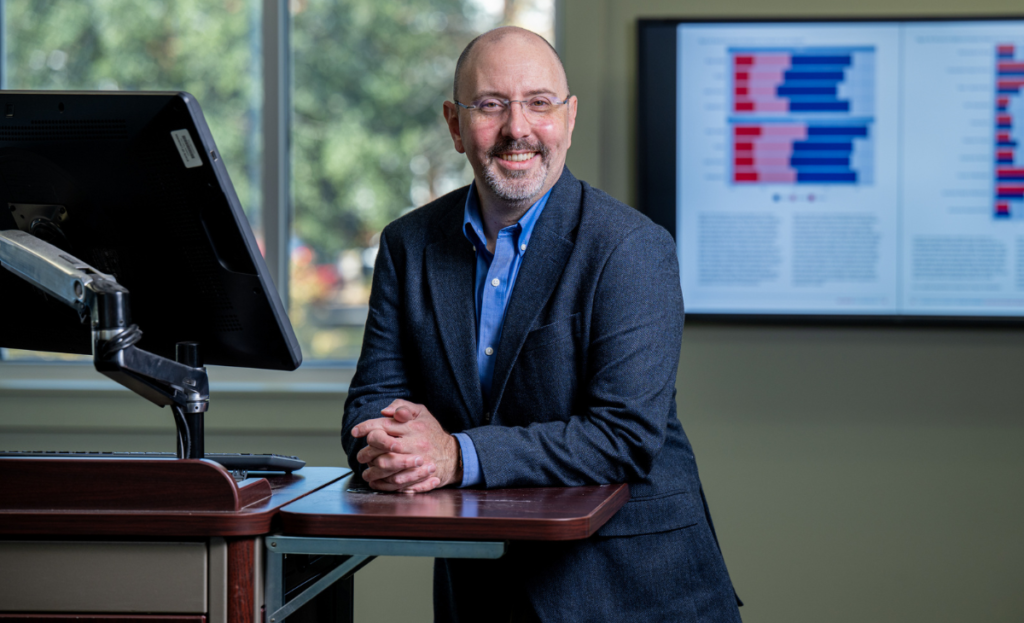
According to Scott, that combination allows the Center’s work to evolve continuously as economic conditions — and student interests — change.
At the heart of the Center’s work is a commitment to student engagement. Economics and finance students play an active role in CER research, gaining experience that mirrors professional economic analysis.
“Students learn how to frame research questions, work with large datasets, apply statistical and econometric tools, and translate technical findings into accessible conclusions,” said Scott. “For many, this is their first opportunity to conduct research that reaches far beyond the classroom.”
Students learn how to frame research questions, work with large datasets, apply statistical and econometric tools, and translate technical findings into accessible conclusions.”
PATRICK SCOTT
The result is a powerful real-world learning experience. Students graduate with published work and a deeper understanding of how economic analysis informs decision-making in public and private sectors.
One of the CER’s most visible contributions is the Regional Economic Analysis of Louisiana (REAL) Report, a quarterly publication examining key economic trends affecting the state and region.
Produced by Scott and students enrolled in the Regional Economic Analysis course, the REAL Report provides insight into employment, wages, industry performance, housing markets, and economic forecasts. Each issue is written for a broad audience — lawmakers, business owners, employer partners, and economic development professionals — making rigorous analysis accessible and actionable.
“It gave context to the ‘why’ of everything I had studied up to that point,” said Quentin Jones, a 2020 Louisiana Tech graduate. “Paring the information down so that I could communicate as much of the insights of the data as possible was easily the most challenging part of the project, but seeing the breadth of what the tools in economics are capable of was invaluable.”
Over the past seven years, students have conducted analysis on a number of timely topics, including the economic impact of the COVID-19 pandemic, how the enrollment of one Louisiana Tech student affects the local and state economy, and factors behind health insurance struggles in the South.
“I enjoyed learning how to ask and answer my own research questions and get my research published in a university publication,” said Jared Johnson, another 2020 graduate who participated in the course. “I felt prepared to conduct research in a professional setting, and I gained a deeper knowledge of and appreciation for Louisiana through my work.”
The Center also sponsors an annual College of Business Research Forum that serves as opportunity for undergraduate, graduate, and doctoral students to present original research.
Looking ahead, two new programs are in development to further enhance the Center’s curricular integration: an MBA concentration in Regional Economic Development and a graduate certificate in Regional Economic Development. Both are designed to provide economic development professionals with a pathway to advanced training and professional development.
“No two academic years are the same,” said Scott. “In many ways, the CER embodies some of the most rewarding parts of my professional career because I can merge passions for student research with solving critical economic development challenges for the region.”
